


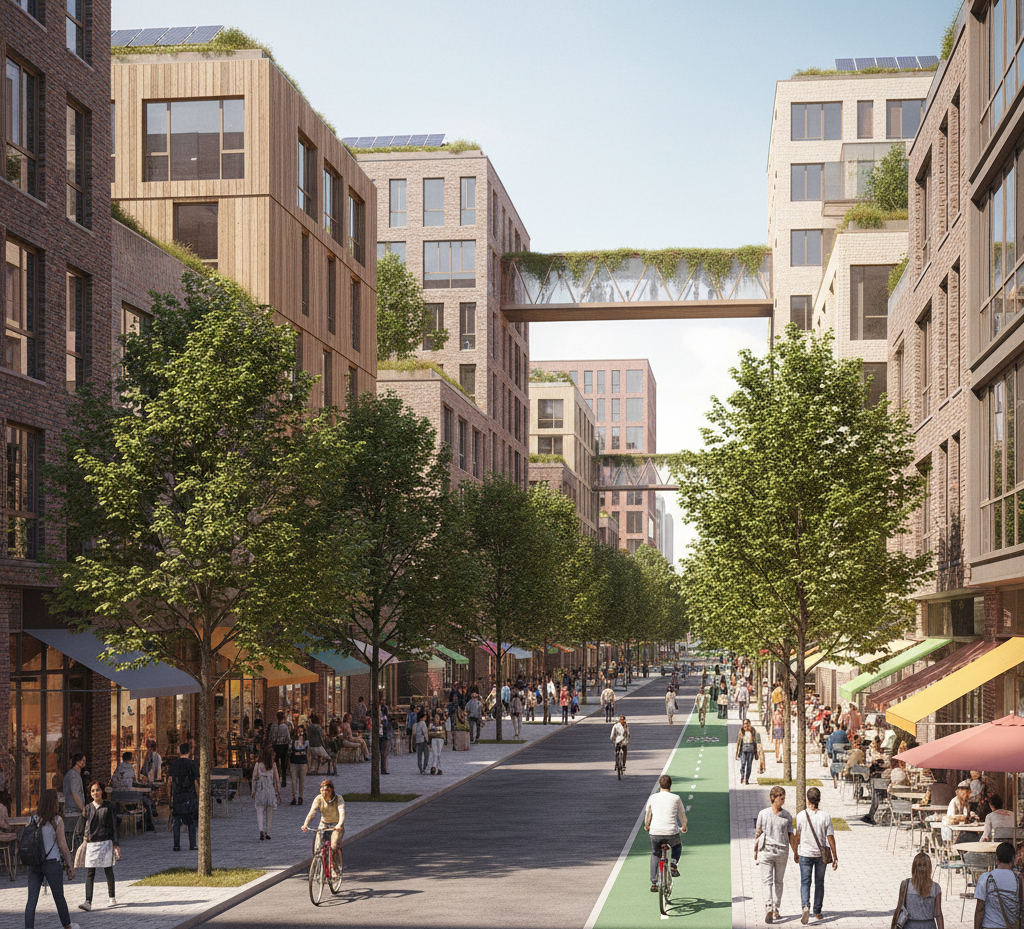
Validate compact city development scenarios, density configurations, and mixed-use programme mixes — enabling faster, evidence-based planning decisions.
Compact city planning requires balancing high-density development, mixed-use programme, amenity provision, and infrastructure capacity within constrained urban boundaries. Getting it wrong creates liveability and infrastructure problems that are difficult to reverse — and planning errors made now will shape urban outcomes for generations.
| Without DBF | With DBF |
|---|---|
Density configurations and mixed-use ratios balanced manually |
AI generates and scores 50+ compact city scenarios against density, liveability, and infrastructure KPIs |
Amenity and infrastructure capacity checked late in planning |
Every requirement validated before planning applications are submitted |
Sustainability targets bolted on after spatial planning |
Embodied carbon, operational energy, and liveability integrated from the first iteration |
Stakeholder scenarios produced one at a time |
Multiple development options compared simultaneously for alignment |
Upload site boundaries, GIS data, demographic datasets, and planning policy constraints. DBF integrates multi-source data into a single spatial model.
AI generates 50+ development scenarios — each scored against planning, liveability, sustainability, and infrastructure KPIs simultaneously.
Every land use configuration, density gradient, and infrastructure relationship is evaluated. Conflicts and opportunities surface with spatial evidence.
Scenarios are automatically scored against liveability, sustainability, infrastructure capacity, and planning policy compliance.
Comparable scenario outputs ready for planning authority, investor, and community stakeholder review from day one — not after weeks of consultant work.
Planning-authority-ready evidence outputs and spatial data exports delivered from the feasibility stage — not the planning application stage.
Every DBF capability is designed for the specific demands of compact city planning — where density, mixed-use programme, and infrastructure capacity interact within constrained urban land budgets.
Validate compact city development scenarios against planning policy, density targets, infrastructure capacity, and liveability requirements before planning submission.
Test high-density mixed-use configurations against infrastructure investment, sustainability KPIs, and investor return targets before committing to planning.
Assess compact city growth scenarios against demographic demand, infrastructure capacity, and sustainability targets simultaneously across multiple locations.
Deliver faster, more evidence-based compact city feasibility with validated spatial scenarios, KPI scoring, and planning-authority-ready outputs.
As urban land becomes increasingly constrained and sustainability requirements tighten, compact city planning will require greater analytical precision and faster iteration. The pressure to deliver more homes, more amenity, and better infrastructure within smaller land budgets will intensify. DBF enables teams to validate more options earlier with greater planning confidence — delivering compact city programmes that are liveable, sustainable, and investable.