
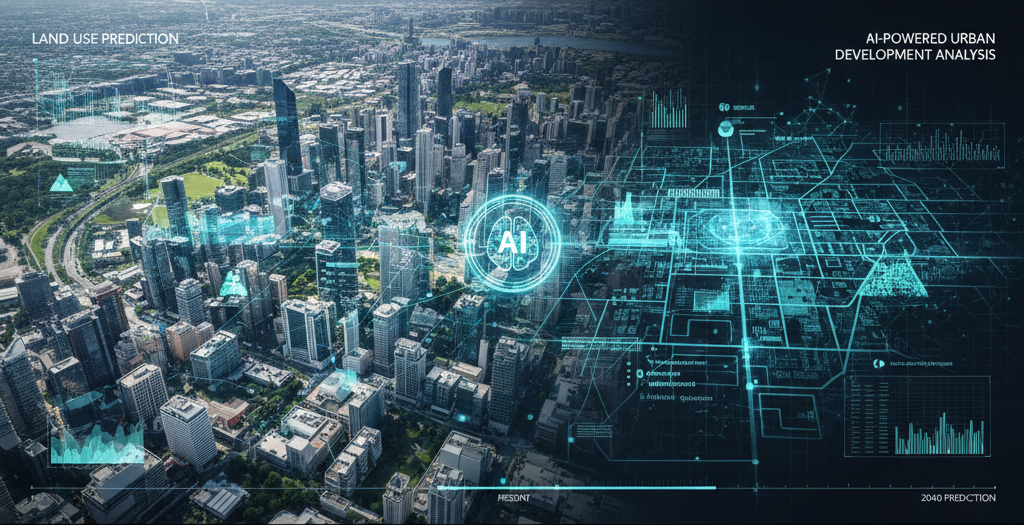

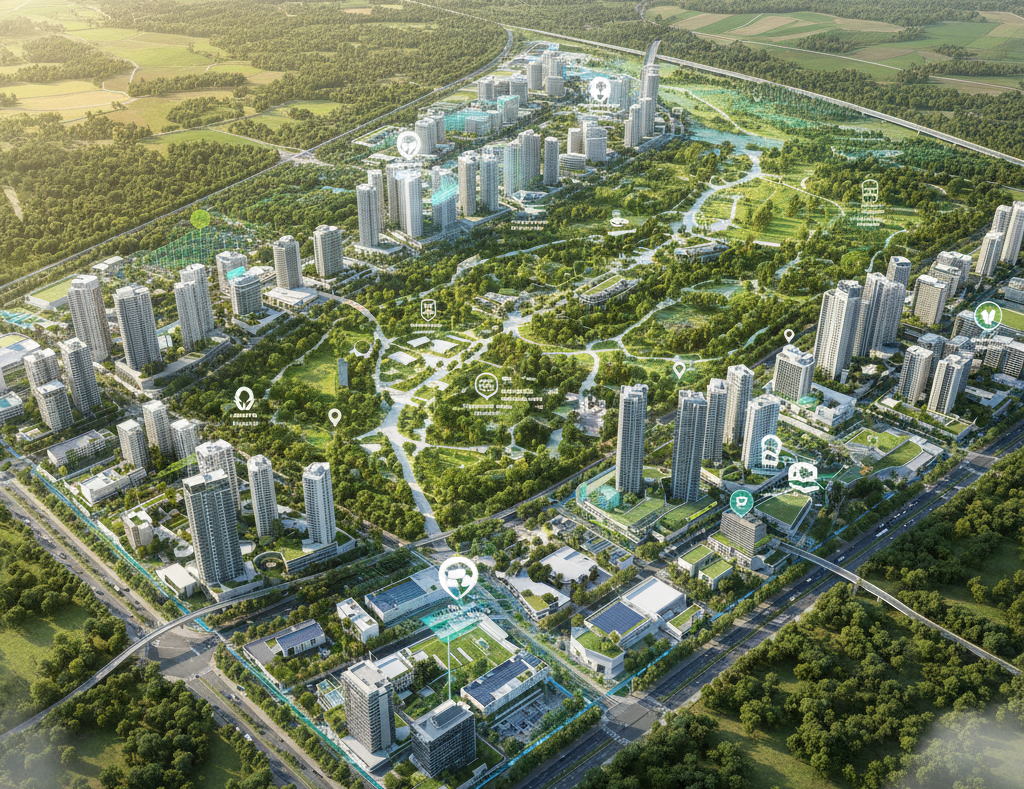
Model land use change scenarios, development potential, and demand forecasts — enabling data-driven planning policy decisions before development begins.
Land use planning decisions made without predictive spatial modelling create mismatches between housing supply, employment land, infrastructure capacity, and demand — issues that are expensive and slow to correct over decades. Planning authorities that make decisions without adequate evidence risk delivery failures that affect communities for a generation.
| Without DBF | With DBF |
|---|---|
Land use change assessed using historical data and planner intuition |
AI-driven land use change models incorporating demographic, economic, and spatial data |
Development potential scored manually across candidate sites |
Automated development potential scoring against planning and investment criteria |
Infrastructure and demand projections produced in separate workstreams |
Infrastructure demand, land use, and population growth co-modelled simultaneously |
Policy scenarios evaluated one at a time |
Multiple planning policy scenarios compared simultaneously |
Upload site boundaries, GIS data, demographic datasets, and planning policy constraints. DBF integrates multi-source data into a single spatial model.
AI generates 50+ development scenarios — each scored against planning, liveability, sustainability, and infrastructure KPIs simultaneously.
Every land use configuration, density gradient, and infrastructure relationship is evaluated. Conflicts and opportunities surface with spatial evidence.
Scenarios are automatically scored against liveability, sustainability, infrastructure capacity, and planning policy compliance.
Comparable scenario outputs ready for planning authority, investor, and community stakeholder review from day one.
Planning-authority-ready evidence outputs and spatial data exports delivered from the feasibility stage.
Every DBF capability is designed for the specific demands of land use prediction — where demographic change, economic growth, and infrastructure capacity interact across planning policy decisions that shape cities for decades.
Validate land use change scenarios and development potential assessments against demographic demand, infrastructure capacity, and planning policy targets before policy adoption.
Model land use change across regions, comparing housing, employment, and infrastructure scenarios against demographic and economic forecasts simultaneously.
Co-model infrastructure demand and land use change to identify capacity constraints before development programmes are committed.
Deliver faster, more evidence-based land use assessment with validated predictive models, development potential scoring, and planning-authority-ready outputs.
As planning authorities face growing pressure to deliver evidence-based policy decisions faster, land use prediction will become a core planning tool. The volume and complexity of data that planners must integrate will increase, and the cost of policy decisions without spatial evidence will grow. DBF enables planners to move from reactive data analysis to proactive, predictive spatial strategy — delivering the land use evidence that modern planning authorities need to make faster, more confident decisions.