

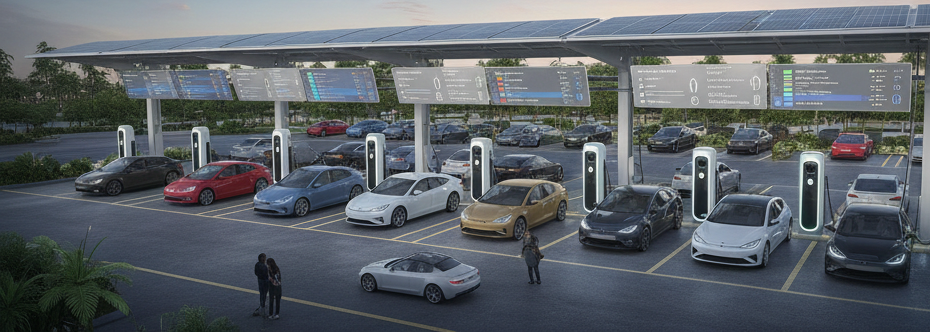

Validate EV charging infrastructure layouts, grid connection demands, and site feasibility — enabling faster investment decisions for EV network operators.
EV site planning errors — undersized grid connections, suboptimal charger placement, or poor site access — reduce utilisation and revenue for the operational life of the asset. In a sector where site performance directly determines network ROI, these are not recoverable mistakes.
| Without DBF | With DBF |
|---|---|
Charger placement and site coverage optimised in separate workstreams |
AI generates EV site layouts scored against utilisation and coverage KPIs |
Grid connection and power demand estimated |
Demand modelled from charger configurations before grid applications |
Site access, circulation, and queuing planned intuitively |
Access, vehicle routing, and queuing scenarios tested simultaneously |
Future charger density assumed |
Scalability scenarios tested for network growth and technology upgrades |
Upload production flow requirements, site constraints, and operational targets. DBF maps process data to spatial parameters.
The AI generates factory layout configurations scored against production flow, efficiency, and brief compliance.
Every production adjacency and process relationship validated before design begins. Conflicts surface at feasibility with impact scores.
Specialist utilities, high-voltage, and MEP infrastructure demands modelled from process and production data — not estimated.
Safety zoning, hazardous material areas, and regulatory requirements validated at feasibility stage, not detailed design.
Validated factory layouts, process flows, and infrastructure data export directly to BIM, eliminating manual re-entry.
Every DBF capability is designed for the specific demands of EV site planning — where charger placement, grid demand, and site access interact to determine operational performance from day one.
Validate site layouts, charger configurations, and grid connection requirements across multiple candidate sites before committing network investment.
Test EV charging site configurations against utilisation projections, grid connection costs, and planning requirements before committing to development.
Validate depot charging infrastructure layouts, grid connection demands, and charging schedule optimisation before committing to electrification investment.
Assess public EV charging network site options against coverage targets, grid capacity, and planning authority requirements simultaneously.
As EV adoption accelerates and charging infrastructure demand intensifies, the need for data-driven EV site planning will grow. Grid connections will become constrained, planning requirements will tighten, and the competition for high-utilisation sites will increase. DBF enables faster, smarter feasibility for the charging networks underpinning transport decarbonisation — giving network operators and developers the spatial evidence to commit earlier and perform better.