

Healthcare & Research

Research Labs

Validate research laboratory adjacencies, containment requirements, and specialist infrastructure — before design decisions affect scientific performance for decades.

Also in Healthcare & Research Medical Centers Hospitals Laboratories
Research laboratory facility with containment zones, specialist MEP infrastructure, and scientific workflow corridors
Trusted by
TAKENAKA Jacobs EMAAR McKinsey Dubai Municipality egis
The Problem

Research lab adjacency failures compromise scientific quality and safety

Research laboratory adjacency failures — incompatible containment zones, misaligned MEP infrastructure, or poor circulation between lab types — compromise scientific quality and safety for the operational life of the facility. In a sector where scientific performance and biosafety compliance are non-negotiable, planning errors are a risk that no institution can afford.

Without DBF With DBF
Lab adjacencies and containment requirements validated manually
AI validates every containment and adjacency requirement against research relationship matrices
MEP and specialist infrastructure estimated in early planning
Specialist infrastructure and utilities modelled from lab type and containment data
Regulatory and biosafety compliance checked in detailed design
Compliance checking embedded in feasibility generation from the first iteration
Future research programme flexibility assumed
Scalability and change-of-use scenarios tested against spatial and infrastructure limits
Process

How It Works

01
Clinical Brief Mapping

Upload departmental brief, clinical relationship matrices, and site constraints. DBF maps clinical requirements to spatial parameters.

02
Layout Generation

AI generates clinical facility configurations scored against departmental adjacency, patient flow, and clinical KPIs simultaneously.

03
Adjacency Validation

Every departmental relationship validated against clinical matrices. Conflicts surface with impact scores before any design work begins.

04
Compliance Checking

Infection control zoning, regulatory requirements, and clinical compliance validated from the first generated layout — not detailed design.

05
Infrastructure Sizing

Specialist MEP, medical gas, and utilities demands modelled from departmental data — not estimated at programme stage.

06
BIM Handoff

Validated clinical layouts, adjacency data, and infrastructure sizing exported directly to clinical design teams, eliminating manual re-entry.

Platform

Built for research laboratory planning complexity

Every DBF capability is designed for the specific demands of research lab planning — where containment requirements, scientific adjacency, specialist infrastructure, and biosafety compliance interact across facilities that must perform for decades.

  • AI research lab layout generation
  • Containment and adjacency validation
  • Specialist MEP and utilities demand modelling
  • Regulatory and biosafety compliance checking
  • Scalability and change-of-use scenario testing
  • BIM handoff exports
Who Uses DBF

Use Cases

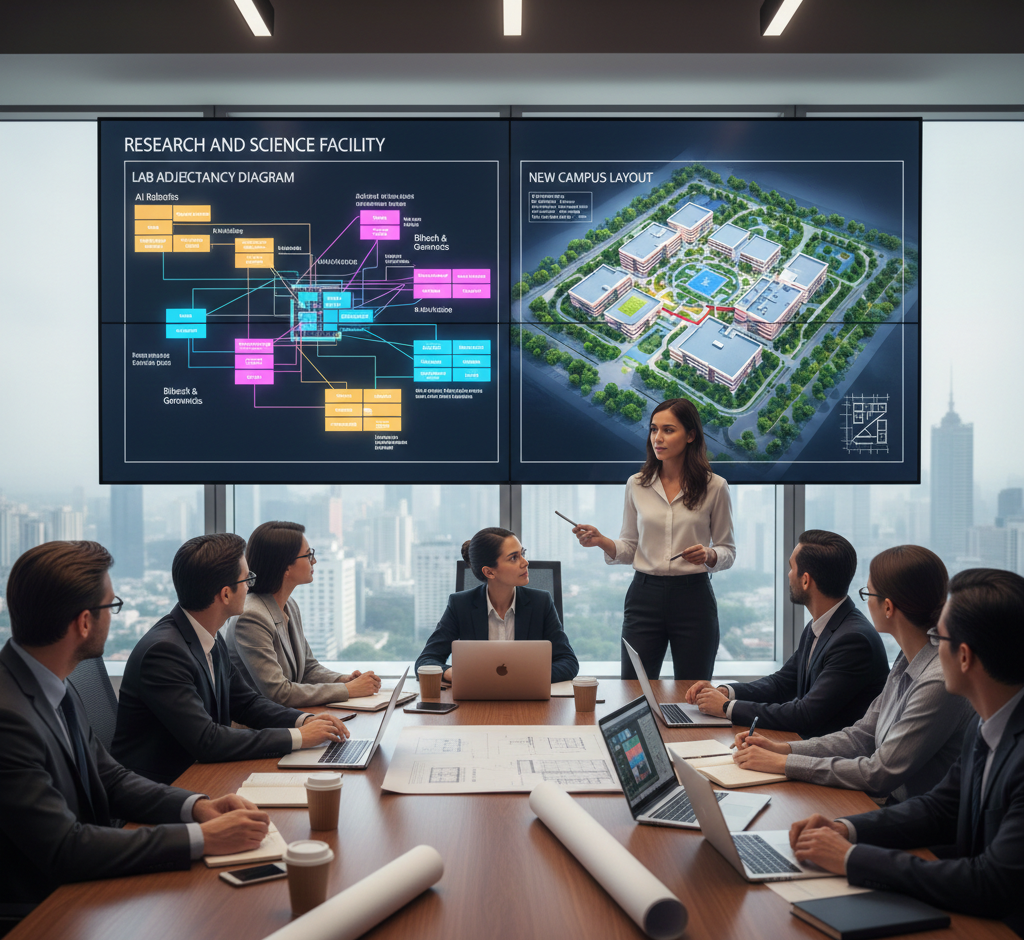
Research facility planning team reviewing containment zone adjacency, biosafety compliance, and specialist infrastructure configurations
01
Universities
Research Facilities Head

Validate research laboratory configurations against containment requirements, scientific adjacency needs, and MEP infrastructure demands before committing to design.

02
Life Science Developers
Development Director

Test multi-tenant research facility configurations against containment zoning, shared infrastructure requirements, and long-term programme flexibility.

03
Government Research
Infrastructure Head

Assess research facility development scenarios against scientific programme requirements, containment standards, and infrastructure investment constraints simultaneously.

04
AEC Consultancy
Project Director

Deliver faster, more evidence-based research lab feasibility with validated containment analysis, specialist infrastructure sizing, and BIM-ready outputs.

Clinical
Adjacency Validated
Before design begins
Zero
Zone Conflicts
Caught at feasibility
Decades
Impact Shaped
By feasibility decisions
Future Vision

Planning for the global acceleration of life science investment

As life science investment and research campus development accelerate globally, the complexity of research laboratory planning will intensify. Containment requirements will evolve, research programmes will diversify, and the infrastructure demands of laboratory facilities will grow. DBF enables teams to validate laboratory configurations earlier — with greater scientific and regulatory confidence than traditional planning workflows allow.

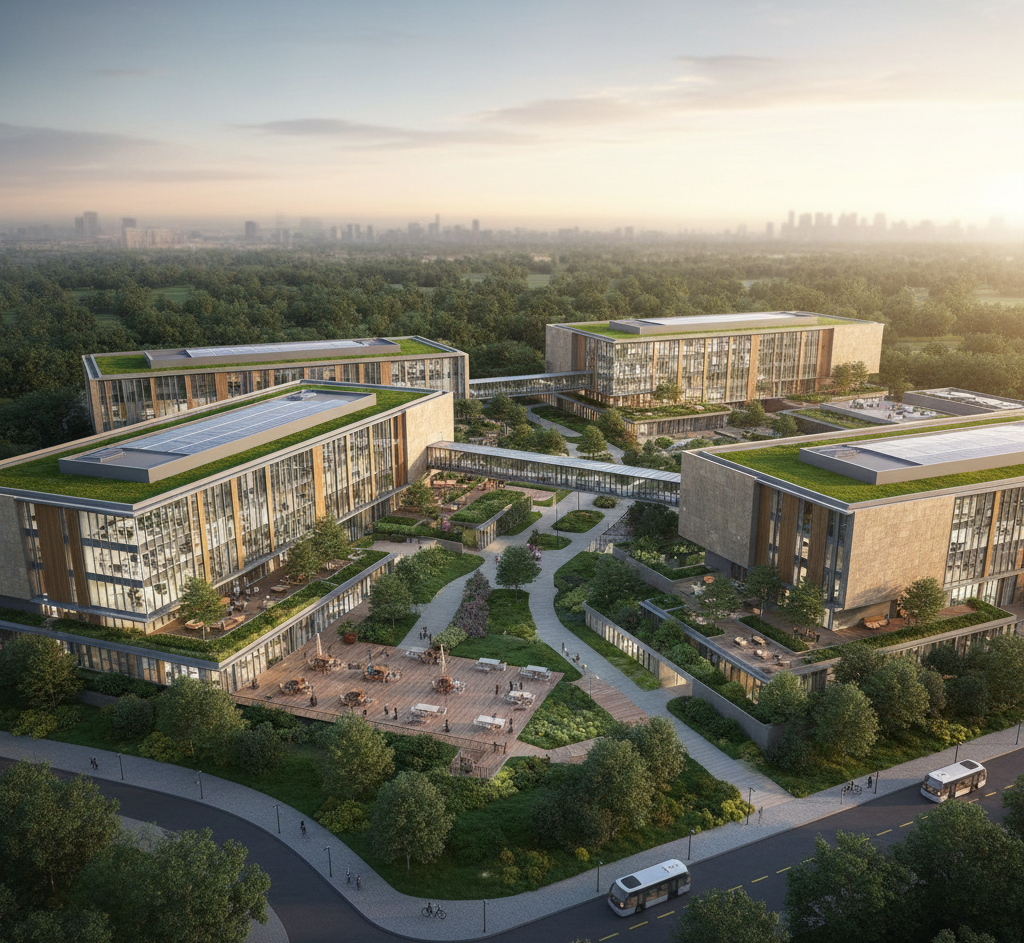
Future vision of a life science research campus with validated containment, adjacency, and specialist infrastructure