
AI-Powered Parametric Design Platforms for Enterprise Development Teams
Parametric design has existed in architecture for decades, but the arrival of AI-native platforms is fundamentally changing what the methodology can deliver at enterprise scale. Where traditional parametric workflows required specialist scripting knowledge and significant manual configuration, AI-driven parametric design platforms now allow development teams to generate and evaluate hundreds of design scenarios, constrained by real feasibility parameters within hours rather than weeks. · June 2, 2026


Parametric design has existed in architecture for decades, but the arrival of AI-native platforms is fundamentally changing what the methodology can deliver at enterprise scale. Where traditional parametric workflows required specialist scripting knowledge and significant manual configuration, AI-driven parametric design platforms now allow development teams to generate and evaluate hundreds of design scenarios, constrained by real feasibility parameters within hours rather than weeks. This article examines what parametric design architecture means in practice, where the current generation of tools falls short, and how AI generative design engines are closing the gap between design exploration and commercial viability for senior decision-makers at large AEC and development firms.
What Is Parametric Design?
Parametric design is a computational methodology in which design outcomes are defined not by fixed geometry but by relationships between adjustable parameters. A parametric building model is, in essence, a set of rules: if floor plate dimensions change, the structural grid updates; if the site boundary shifts, the setback calculations recalculate; if GFA requirements are revised, the floor count adjusts accordingly. The design is driven by logic rather than by static drawing.

In architecture, parametric design software has historically been associated with complex curved geometry, the undulating facades of Zaha Hadid Architects, and the adaptive shell structures of Arup's Advanced Geometry Unit. But parametric logic applies equally to rectilinear massing, mixed-use masterplanning, and feasibility analysis. The power of the methodology is not aesthetic; it is computational speed. A parametric model that takes ten seconds to regenerate with new inputs enables a fundamentally different quality of design exploration than one that takes a draughtsman three days to redraw.
3D parametric design software such as Grasshopper (running on Rhino), Dynamo (integrated with Revit), and more recently AI-native platforms like Digital Blue Foam, operationalises this logic in different ways. What distinguishes the latest generation is the addition of AI-driven option generation; the software does not merely respond to parameter changes, it proposes new parameter combinations based on feasibility and performance objectives.
Why Parametric Design Matters for Modern Planning and Development Teams
The commercial case for parametric design architecture at an enterprise scale is straightforward: development economics reward speed, accuracy, and optionality. A planning team that can evaluate fifteen massing configurations against site constraints, planning regulations, and projected GFA yield in a single working day has a structural advantage over one that must wait three weeks for each design iteration to be manually drafted, reviewed, and documented.
According to McKinsey's 2020 report on the construction industry, large construction projects take 20% longer to complete than scheduled and run 80% over budget on average. A significant contributor to both patterns is the inefficiency of the early design and feasibility phase where decisions with the highest long-term cost implications are made using the least information. Parametric design software addresses this directly by compressing the information-gathering phase of concept design.
For masterplanners and urban development teams, AI parametric design tools carry additional significance. At the masterplan scale, the number of design variables, plot ratios, land-use mix, road network configurations, open space ratios, building height profiles is too large to explore exhaustively by hand. Parametric logic applied at this scale does not just speed up the process; it makes certain kinds of analysis structurally possible for the first time.
Key Challenges in Traditional Parametric Design Approaches
Despite the methodology's advantages, traditional parametric design workflows carry three significant barriers that limit their adoption in enterprise development organisations.
The first barrier is technical gatekeeping. Grasshopper, the most widely used parametric design platform in architecture, requires proficiency in visual programming. Setting up a functional parametric script for a complex mixed-use development can take an experienced specialist several days. This means that parametric design capability is concentrated in a small subset of the design team, typically specialist computational designers, rather than being accessible to the architects, planners, and project managers who need the outputs. The result is a bottleneck: parametric analysis happens when the specialist is available, not when the project needs it.
The second barrier is the feasibility gap. Traditional 3D parametric design software is powerful at generating geometric variation but has no intrinsic awareness of commercial feasibility. A Grasshopper script can produce five hundred facade configurations but cannot rank them by lettable floor area efficiency, construction cost per m², or planning authority compliance. Connecting parametric geometry to feasibility data requires additional scripts, manual data entry, or external modelling, each of which adds time and complexity.
The third barrier is the disconnect from downstream workflow. Geometry generated in a parametric environment often cannot be directly imported into BIM authoring tools without substantial manual rework. The Rhino-to-Revit translation process, for example, typically requires time-consuming geometry cleanup that defeats the speed advantage parametric modelling was supposed to deliver.
How AI and Spatial Analytics Are Transforming Parametric Design
AI-powered parametric design platforms address these barriers by shifting from script-based to intent-based operation. Rather than requiring the user to define the parametric rules explicitly, the AI engine infers constraints from site context, planning regulations, and project brief, then generates options that satisfy those constraints automatically.

This changes the user experience from programming to directing. A planning director can specify objectives like maximise GFA, maintain 35% open space, observe 18-metre height limit on the northern boundary, achieve a 40% residential mix, and the AI engine generates a set of massing options that satisfy those constraints simultaneously. Each option comes with associated metrics: GFA yield, unit count, floor efficiency ratios, approximate construction cost bands. The design team evaluates candidates rather than generating them.
Spatial analytics augments this by contextualising the generated options against the physical and regulatory environment. Shadow impact on adjacent properties, solar access to proposed courtyards, wind tunnel effects in the street canyon, and pedestrian connectivity metrics can all be layered onto the generated massing options, providing a multi-criteria evaluation framework that would take weeks to assemble manually.
The integration of AI parametric design with real-time environmental analysis is particularly significant for urban development teams working in complex city environments. Unlike standalone simulation tools that require geometry to be exported, cleaned, and re-imported, AI-native platforms maintain a live connection between design geometry and analytical outputs, meaning that every generated option is simultaneously evaluated for environmental performance.
Parametric Design Architecture Use Cases With Real-World Examples
Use Case 1: Mixed-Use Masterplan Option Generation
A real estate development firm working on a 12-hectare brownfield site in a regulated urban zone needs to evaluate land-use distribution scenarios before committing to a planning application. The variables include residential GFA, commercial ground floor area, public open space ratios, and building height profiles across nine development plots. Under a traditional workflow, each scenario would require a manual design iteration. Using AI parametric design software, the team generates 200+ scenarios in a single session, filters to those meeting planning compliance thresholds, and shortlists eight candidates for detailed evaluation. The process takes two days rather than six weeks.
Use Case 2: Residential Tower Envelope Optimisation
An architecture firm designing a 40-storey residential tower in a high-density urban context needs to evaluate the unit mix implications of three different structural grid configurations. Each grid option produces different floor plate shapes, affecting the proportion of one-, two-, and three-bedroom units achievable within the GFA envelope. Using parametric design software integrated with unit mix feasibility data, the team models all three structural options simultaneously and quantifies the revenue differential between configurations, providing the client with a financially grounded basis for a structural specification decision that would otherwise have been made on engineering preference alone.
How Digital Blue Foam Supports Parametric Design Workflows
Digital Blue Foam's AI Generative Design engine is purpose-built for the enterprise development context. Unlike Grasshopper or Dynamo, which require scripting expertise, DBF's platform generates multiple design scenarios guided by feasibility and novelty algorithms based on project brief inputs, allowing planning teams without specialist computational design skills to access parametric design methodology's core benefits.
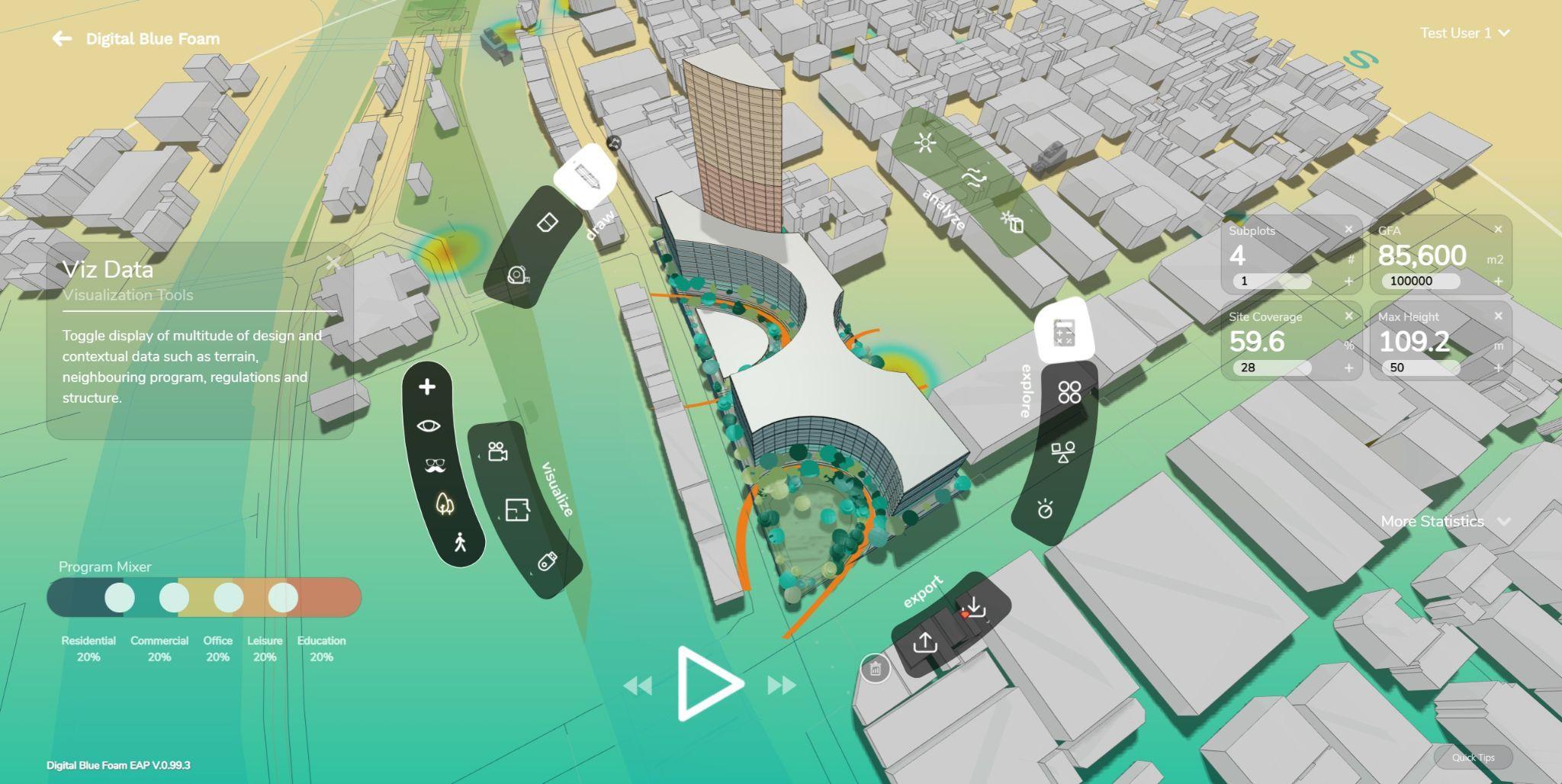
The engine enables teams to explore hundreds of massing options in hours rather than weeks, with each option automatically validated for massing compliance, density targets, and daylight performance. For enterprise development teams managing multiple concurrent projects, DBF's platform provides a consistent methodology for early-stage option generation that does not depend on individual specialist availability.
Clients including Jacobs, Takenaka, Emaar, and Dubai Municipality have used DBF's AI Generative Design capability to accelerate feasibility studies, stress-test planning submissions, and present evidence-backed massing recommendations to steering committees, compressing the concept design phase while increasing the rigour of the analysis it produces.
Best Practices for Parametric Design Implementation in Enterprise Organisations
Implementing parametric design software across an enterprise AEC organisation requires more than tool adoption. It requires a structured approach to standardisation, skill development, and workflow integration.
The first priority is establishing a common parameter library. For parametric design to be scalable across an organisation, the design rules, setback requirements by planning authority, structural grid preferences by building type, unit mix targets by market segment, need to be codified consistently. Without this, each project team builds its own parametric environment from scratch, and the speed benefits do not compound.
The second priority is defining the interface between parametric concept tools and downstream BIM workflows. The geometry produced by AI parametric design platforms needs a clear, documented path into the BIM authoring environment. Firms that establish this path early avoid the rework bottleneck that has historically made parametric tools feel faster at concept stage but slower in aggregate.
The third priority is capability distribution. The goal of AI-native parametric design tools is precisely to make parametric methodology accessible to non-specialists. But that requires structured training and a practice change programme. Project leaders need to understand what the tool produces and how to interpret feasibility metrics, even if they are not operating the software directly.
Conclusion
Parametric design architecture has crossed a threshold. The methodology is no longer the domain of specialist computational designers working on bespoke cultural projects, it is an enterprise-grade capability that development teams of all types are using to compress feasibility analysis timelines, expand the design solution space, and make evidence-backed decisions at concept stage.
The integration of AI into parametric design software has removed the principal barrier to enterprise adoption: the need for scripting expertise. Platforms that generate constrained design options automatically, and evaluate them against feasibility, compliance, and environmental performance in real time, are making parametric logic accessible at the organisational level rather than the individual specialist level.
For planning directors and development executives evaluating where to invest in design technology, AI-powered parametric design represents a category of tool whose return on investment accrues in reduced iteration time, better-informed planning submissions, and a quantifiable expansion in the number of design options evaluated before commitment. To see DBF's AI Generative Design engine in operation, book a demo or explore the platform.
FAQs
What is parametric design in architecture?
Parametric design in architecture is a computational methodology in which building geometry and spatial relationships are defined by adjustable rules rather than fixed drawings. When a project variable changes, site boundary, floor-to-ceiling height, planning setback, the parametric model recalculates automatically. In practice, this allows design teams to explore many more configuration options than traditional manual drafting allows, and to evaluate each option against quantified performance criteria such as GFA yield, daylight access, and construction cost estimates.
What is the best parametric design software for enterprise teams?
The best parametric design software for an enterprise team depends on design stage and user profile. Grasshopper and Dynamo are the most powerful tools for specialists requiring full scripting control at detailed design stages. For early-stage concept design and feasibility analysis at enterprise scale, AI-native platforms such as Digital Blue Foam's AI Generative Design engine are better suited. They require no scripting expertise, generate constrained options automatically, and integrate environmental performance metrics directly.
How does AI parametric design differ from traditional parametric software?
Traditional parametric software requires users to explicitly define the parametric rules, the logic that governs how design elements relate to each other. AI parametric design infers these rules from project brief inputs and generates option sets automatically. The practical difference is that traditional tools require specialist scripting expertise and significant setup time, while AI-native tools allow planning directors and project leads without computational design training to access the same methodology.
Can parametric design software integrate with Revit or BIM 360?
Yes, most parametric design environments have defined integration pathways with Revit and BIM 360. Dynamo is natively embedded within Revit. Rhino and Grasshopper integrate through Rhino.Inside.Revit. Newer AI-native platforms provide export formats compatible with standard BIM authoring tools, though the geometry may require cleanup or interpretation at the point of import. Firms with active parametric design workflows should define and document the BIM handoff protocol at the start of each project to avoid geometry translation delays.
Is parametric design suitable for urban masterplanning?
Parametric design is particularly well suited to urban masterplanning, where the number of design variables, land-use distribution, plot ratios, height profiles, street network configurations, open space ratios, exceeds what manual design exploration can practically address. AI-driven parametric platforms that can generate and evaluate thousands of masterplan configurations against planning compliance and feasibility criteria give urban development teams a structured methodology for arriving at an informed shortlist before committing to detailed design.